Pros and Cons of ChatGPT
Published: 1 Nov 2026
Have you ever needed help writing an article, understanding a difficult topic, or finding new ideas? ChatGPT can help with these tasks in just a few steps. It is an AI chatbot that understands questions and generates responses in natural language.
Many students, writers, businesses, and professionals use ChatGPT to make their work easier. However, it also has some limitations. It can provide incorrect information, misunderstand questions, and sometimes make people too dependent on AI.
In this article, I will explain the main pros and cons of ChatGPT, its common uses, important factors to consider, and how to use it responsibly.
Advantages of ChatGPT
There are many advantages of ChatGPT that make it useful for students, professionals, businesses, and everyday users.
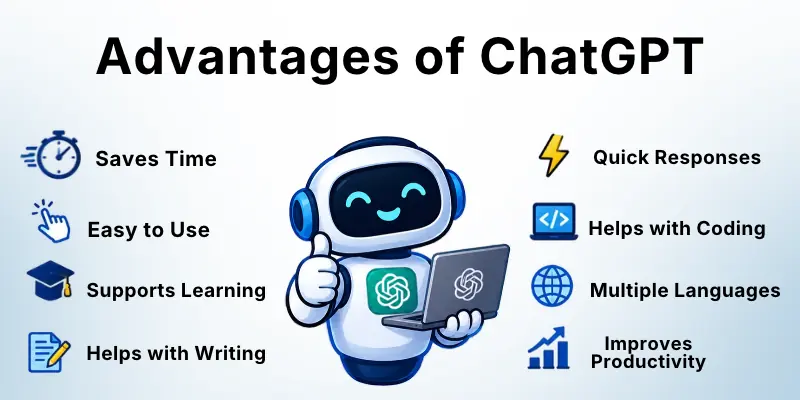
Here are some of its main benefits.
- Saves Time
- Easy to Use
- Supports Learning
- Helps with Writing
- Generates Creative Ideas
- Provides Quick Responses
- Helps with Coding
- Supports Multiple Languages
- Assists with Research
- Improves Productivity
Now, let’s discuss these advantages in detail.
1. Saves Time
One of the main advantages of ChatGPT is that it can help users complete certain tasks more quickly. Instead of starting from a blank page, users can ask it to create an outline, summarize text, or suggest a structure for their work.
This can be useful when someone has several tasks to complete in a limited amount of time. However, the output may still need editing and fact-checking before it is ready to use.
- Creates first drafts quickly.
- Summarizes lengthy text.
- Suggests article outlines.
- Organizes information.
- Helps plan daily tasks.
Use It Wisely: Review the response before using it in important work.
2. Easy to Use
ChatGPT has a conversational interface that allows users to communicate through ordinary language. They do not need to learn complicated commands to ask questions or request help.
Users can also ask follow-up questions to make an answer clearer. This makes it useful for beginners who need explanations without complicated technical language.
- Uses everyday language.
- Accepts direct questions.
- Explains difficult topics.
- Supports follow-up questions.
- Helps users explore new subjects.
Use It Wisely: Write clear questions and include the details that matter.
3. Supports Learning
Students can use ChatGPT to understand topics that they find difficult. It can explain concepts in simpler words, provide examples, and break a large topic into smaller parts.
It can also help students revise lessons and prepare practice questions. However, students should use it as a learning assistant rather than depending on it to complete every assignment.
- Explains complex concepts.
- Provides examples.
- Creates revision questions.
- Summarizes study notes.
- Helps clarify confusing ideas.
Use It Wisely: Try to understand the explanation instead of memorizing it without thinking.
4. Helps with Writing
ChatGPT can assist with many writing tasks, including emails, blog posts, outlines, summaries, and social media captions. It can also suggest alternative wording when a sentence is unclear.
Writers can use it to improve readability and organize their thoughts. Still, the final content should reflect the writer’s purpose, audience, and own judgment.
- Suggests article structures.
- Improves sentence clarity.
- Helps draft emails.
- Recommends alternative wording.
- Organizes ideas into sections.
Use It Wisely: Edit the draft to make sure it matches your voice and requirements.
5. Generates Creative Ideas
Sometimes, people struggle to find a starting point for a project. ChatGPT can suggest topics, headlines, campaign ideas, story concepts, and different ways to approach a problem.
These suggestions can help users explore possibilities they may not have considered. The quality of the ideas depends on the instructions, context, and review provided by the user.
- Suggests blog topics.
- Creates headline ideas.
- Helps with brainstorming.
- Offers different approaches.
- Supports content planning.
Use It Wisely: Treat its suggestions as starting points and develop the strongest ideas further.
6. Provides Quick Responses
ChatGPT can respond to many questions within a short time. This is helpful when users need an initial explanation or want to explore an unfamiliar subject.
However, a quick response does not always mean a correct response. Complex questions may require further research, and recent information may need to be checked against reliable sources.
- Answers many general questions.
- Explains unfamiliar terms.
- Gives initial guidance.
- Helps with simple calculations.
- Suggests possible next steps.
Use It Wisely: Verify important facts instead of assuming every answer is correct.
7. Helps with Coding
Developers and learners can use ChatGPT to understand programming concepts, examine code, and identify possible errors. It can also provide examples of how particular functions or programming techniques work.
This can make coding practice easier, especially when someone needs an explanation of an unfamiliar error. However, generated code may contain bugs, security problems, or outdated methods.
- Explains programming concepts.
- Suggests code examples.
- Helps investigate errors.
- Describes functions.
- Supports coding practice.
Use It Wisely: Test generated code and review its security before using it in a real project.
8. Supports Multiple Languages
ChatGPT can help users understand and produce text in various languages. It can translate passages, explain vocabulary, and help learners practice sentences.
This feature can support communication between people who use different languages. However, translations may miss cultural meaning, regional expressions, or subtle differences in tone.
- Helps translate text.
- Explains vocabulary.
- Supports language practice.
- Rewrites sentences.
- Clarifies unfamiliar expressions.
Use It Wisely: Ask a fluent speaker to review important translations when accuracy matters.
9. Assists with Research
ChatGPT can help users begin researching a subject by explaining key concepts, suggesting questions, and organizing information into useful categories.
It can also help create a research outline before users consult reliable sources. However, its responses should not automatically be treated as verified research, and any references it provides should be checked.
- Identifies subtopics.
- Suggests research questions.
- Organizes key concepts.
- Creates research outlines.
- Helps compare ideas.
Use It Wisely: Confirm important claims through reliable sources and read the original material.
10. Improves Productivity
ChatGPT can support everyday work by helping users plan projects, organize tasks, prepare checklists, and create initial drafts. This can reduce the effort needed to get started.
It may be especially useful when a task involves several steps or requires a clear structure. Its effectiveness still depends on how well users review its output and apply it to their actual needs.
- Creates task lists.
- Helps plan projects.
- Organizes work instructions.
- Drafts routine messages.
- Suggests workflow improvements.
Use It Wisely: Use it for suitable tasks while keeping control of important decisions.
Disadvantages of ChatGPT
Although ChatGPT offers many benefits, it also has disadvantages that users should understand. Its responses may be inaccurate, lack context, or require careful review.
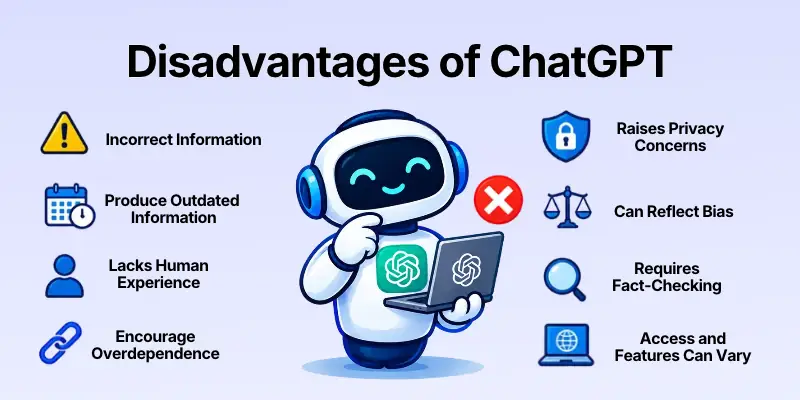
Here are ten important disadvantages of ChatGPT.
- Can Provide Incorrect Information
- May Produce Outdated Information
- Lacks Human Experience
- Can Encourage Overdependence
- May Produce Generic Content
- Raises Privacy Concerns
- Can Reflect Bias
- May Make Mistakes in Complex Tasks
- Requires Fact-Checking
- Access and Features Can Vary
Now, let’s discuss these disadvantages in detail.
1. Can Provide Incorrect Information
ChatGPT can sometimes generate answers that sound convincing but contain mistakes. These errors may involve dates, definitions, explanations, calculations, or other factual details.
This can be a serious problem when users rely on an answer without checking it. The risk is greater when the information affects health, finances, legal matters, or other important decisions.
- Facts may be incorrect.
- Explanations can be misleading.
- Calculations may contain errors.
- Examples may not fit the question.
- Confident wording can hide mistakes.
Avoid This Problem: Check important information against trustworthy sources before acting on it.
2. May Produce Outdated Information
Some answers may not reflect the latest developments, depending on the model, available tools, and information provided in the conversation. Technology, laws, prices, and company policies can change over time.
This means users should be careful when asking about current events, recently released products, or changing rules. A response that was once accurate may no longer be correct.
- News can change quickly.
- Prices may become outdated.
- Software features can change.
- Policies may be updated.
- New research may become available.
Avoid This Problem: Verify time-sensitive details using current official sources.
3. Lacks Human Experience
ChatGPT can discuss emotions, relationships, and personal challenges, but it does not have human feelings or lived experiences. Its responses are generated by an AI system rather than personal memories or real-life experiences.
As a result, its advice may not fully reflect someone’s circumstances or emotional needs. Human judgment and support remain important, especially in sensitive situations.
- Does not have lived experiences.
- May misunderstand emotional context.
- Cannot replace genuine relationships.
- May miss personal details.
- Can offer unsuitable advice.
Avoid This Problem: Use ChatGPT for general guidance, but seek trusted human support when needed.
4. Can Encourage Overdependence
Using ChatGPT for every question or task may reduce opportunities to practice independent thinking. Students, for example, may miss important learning if they copy answers instead of working through problems themselves.
Overdependence can also make it harder to solve problems without AI assistance. The goal should be to strengthen personal skills rather than replace them.
- May reduce independent practice.
- Can discourage problem-solving.
- May weaken writing practice.
- Can create reliance on instant answers.
- May limit personal creativity.
Avoid This Problem: Try solving the task yourself first, then use ChatGPT to review or improve your work.
5. May Produce Generic Content
ChatGPT sometimes creates responses that sound broad or similar to common online content. If the prompt lacks specific details, the result may not reflect the intended audience, brand voice, or unique purpose.
This matters for articles, marketing campaigns, and professional writing where original insight is valuable. Users may need to add relevant examples, specific knowledge, and a clearer point of view.
- Ideas may sound familiar.
- Examples can be too general.
- Tone may not fit the audience.
- Details may be missing.
- Content may need substantial editing.
Avoid This Problem: Provide clear instructions and add original insights that make the content more useful.
6. Raises Privacy Concerns
Users may be tempted to share personal details, business documents, passwords, or confidential information while asking for help. Sharing sensitive information with an online AI service can create privacy and security risks.
The appropriate data controls depend on the service, account, settings, and applicable policies. Users should understand those controls before entering information that should remain private.
- Avoid sharing passwords.
- Protect financial information.
- Remove unnecessary personal details.
- Be careful with confidential documents.
- Review applicable privacy settings.
Avoid This Problem: Share only the information needed for the task and never enter sensitive details unnecessarily.
7. Can Reflect Bias
AI systems learn patterns from data, and those patterns can sometimes include stereotypes or unfair assumptions. As a result, a response may present an unbalanced view of a person, group, topic, or situation.
This is especially important when information is used for education, recruitment, research, or decision-making. Users should examine the reasoning and evidence rather than accepting every response as neutral.
- May repeat stereotypes.
- Can present one-sided views.
- May overlook certain perspectives.
- Can use unfair assumptions.
- May frame topics poorly.
Avoid This Problem: Compare different reliable perspectives and review sensitive responses carefully.
8. May Make Mistakes in Complex Tasks
ChatGPT can assist with complicated questions, but it may misunderstand requirements or overlook important details. This can happen in advanced calculations, technical projects, lengthy instructions, or tasks with several dependencies.
A response may appear complete even when a step is missing. Complex work therefore needs testing, careful review, and sometimes help from a qualified professional.
- May miss important conditions.
- Can make reasoning errors.
- May overlook edge cases.
- Can produce faulty code.
- May misunderstand long instructions.
Avoid This Problem: Break complex tasks into smaller steps and verify each important result.
9. Requires Fact-Checking
Even when a response is useful, users may need to spend additional time checking facts, improving wording, and correcting mistakes. This means ChatGPT does not automatically remove all the work from a task.
Fact-checking is especially important when the content will be published, submitted for academic assessment, or used to make a decision. The effort required depends on the topic and the accuracy needed.
- Check factual claims.
- Review names and dates.
- Confirm sources and references.
- Edit unclear sentences.
- Test technical suggestions.
Avoid This Problem: Include time for review in your workflow instead of publishing the first response immediately.
10. Access and Features Can Vary
ChatGPT’s available models, tools, usage limits, and features may differ depending on the plan, account, region, and current product availability. Some tasks may also require an internet connection or access to a particular feature.
These differences can affect how people use the service for study or work. Users should not assume that every feature is available to everyone or that access will always remain unchanged.
- Usage limits may apply.
- Features can differ by plan.
- Availability may vary by region.
- Some tools require internet access.
- Product features can change.
Avoid This Problem: Check the current official ChatGPT information to understand which features are available to you.
Common Uses of ChatGPT
ChatGPT can support different activities in education, business, technology, and everyday life. Its usefulness depends on the task and how carefully the response is checked.
| Area | Common Uses |
| Education | Explaining lessons, making practice questions, summarizing notes |
| Content Writing | Drafting articles, outlining posts, improving readability |
| SEO | Brainstorming keywords and topics, creating content outlines |
| Business | Drafting emails, organizing ideas, preparing checklists |
| Programming | Explaining code, suggesting fixes, learning concepts |
| Language Learning | Practicing vocabulary, translating text, correcting sentences |
| Personal Planning | Creating schedules, organizing tasks, planning projects |
| Customer Support | Drafting replies and preparing responses to common questions |
Factors to Consider Before Using ChatGPT
Before using ChatGPT for a task, consider what you need and how important accuracy is. These factors can help you decide when AI assistance is appropriate.
- Purpose: Identify the task you want help with.
- Accuracy: Decide whether the answer needs independent verification.
- Privacy: Avoid sharing confidential or sensitive information.
- Originality: Add your own ideas and relevant knowledge.
- Time: Include time for reviewing and editing the output.
- Cost: Check whether your intended features are included in your available plan.
- Skill Development: Make sure using AI does not prevent you from learning important skills.
Common Mistakes to Avoid When Using ChatGPT
Some mistakes can reduce the usefulness of ChatGPT or lead to misleading results. Avoiding these habits can help you get better responses.
- Trusting Every Answer: AI responses can contain errors, so verify important claims.
- Using Vague Prompts: Explain your goal, audience, and requirements clearly.
- Sharing Sensitive Information: Do not enter passwords or unnecessary private details.
- Copying Content Without Review: Check accuracy, relevance, and originality.
- Ignoring Official Sources: Use reliable references for important information.
- Depending on AI for Everything: Continue practicing your own skills and judgment.
- Using Unverified References: Confirm that cited sources exist and support the claims.
- Skipping Final Editing: Make sure the response fits the task before using it.
How to Use ChatGPT Effectively
You can get more useful results by giving clear instructions and checking the output before relying on it.
- Start with a Clear Goal: Explain what you want ChatGPT to help you achieve.
- Provide Relevant Context: Include the necessary background without sharing sensitive information.
- Specify the Format: Mention whether you need a list, table, explanation, outline, or draft.
- Ask Follow-Up Questions: Request clarification when something is unclear.
- Check Important Facts: Verify claims using reliable and current sources.
- Edit the Response: Adapt the wording and details to your needs.
- Use Your Own Judgment: Make the final decision yourself, especially when the task is important.
ChatGPT: Advantages vs. Disadvantages
| Advantages | Disadvantages |
| Saves time on many tasks | Can provide incorrect answers |
| Easy to use | May misunderstand questions |
| Supports learning | Can encourage overdependence |
| Helps with writing | May produce generic content |
| Generates ideas | May lack important context |
| Provides quick responses | May provide outdated details |
| Assists with coding | Generated code can contain errors |
| Supports multiple languages | Translations may miss nuances |
| Helps organize research | References need verification |
| Supports productivity | Requires review and human judgment |
Final Thoughts
ChatGPT can be a useful tool for learning, writing, brainstorming, coding, and organizing everyday tasks. It can help users save time and understand difficult topics when they give clear instructions.
However, it also has limitations. Its responses may contain mistakes, outdated details, bias, or generic information. Privacy and overdependence are also important concerns.
The best approach is to use ChatGPT as an assistant rather than a replacement for human thinking. Check important information, protect your privacy, and add your own knowledge before using its responses. With responsible use, you can benefit from its strengths while reducing the risks.
Frequently Asked Questions (FAQs)
Now, let’s explore some frequently asked questions
1. What are the main advantages of ChatGPT?
The main advantages include saving time, helping with writing, supporting learning, generating ideas, explaining concepts, and assisting with coding and planning.
2. What are the disadvantages of ChatGPT?
Its disadvantages include incorrect information, possible outdated details, generic responses, privacy concerns, bias, and the risk of becoming too dependent on AI.
3. Is ChatGPT useful for students?
Yes. Students can use it to understand lessons, practice questions, summarize notes, and clarify difficult concepts. They should still complete their own learning and follow their school’s academic rules.
4. Can ChatGPT make mistakes?
Yes. ChatGPT can generate incorrect or misleading information. Important claims should be checked against reliable sources.
5. Can ChatGPT replace human writers?
ChatGPT can assist with drafting and editing, but it does not fully replace human judgment, subject knowledge, personal insight, or editorial responsibility.
6. Is ChatGPT safe to use?
It can be useful when used carefully, but users should protect sensitive information, check important answers, and understand the service’s privacy controls.
7. Can ChatGPT help with SEO?
Yes. It can help brainstorm topics, create content outlines, explain SEO concepts, and improve readability. Keyword data, search intent, factual claims, and final content still need human review.
8. Is ChatGPT always free?
Not necessarily. Access to ChatGPT and its features depends on the current plans and availability. Users should check the official ChatGPT website for up-to-date details.
9. Can ChatGPT help with programming?
Yes. It can explain programming concepts, provide code examples, and help investigate errors. Generated code should be tested and reviewed before being used.
10. What is the best way to use ChatGPT?
Give clear instructions, provide relevant context, ask follow-up questions, verify important information, and use your own judgment before applying the response.






- Be Respectful
- Stay Relevant
- Stay Positive
- True Feedback
- Encourage Discussion
- Avoid Spamming
- No Fake News
- Don't Copy-Paste
- No Personal Attacks
- Be Respectful
- Stay Relevant
- Stay Positive
- True Feedback
- Encourage Discussion
- Avoid Spamming
- No Fake News
- Don't Copy-Paste
- No Personal Attacks
