Advantages and Disadvantages of AI
Published: 1 Nov 2026
Artificial Intelligence (AI) is becoming an important part of our daily lives. From search engines and chatbots to online shopping and healthcare, AI helps people complete many tasks more quickly and easily. It can analyze information, recognize patterns, answer questions, and support decision-making.
However, AI also has some disadvantages. It can produce incorrect information, affect certain jobs, create privacy concerns, and make people too dependent on technology. Understanding both sides can help us use AI more responsibly.
In this article, I will explain the advantages and disadvantages of Artificial Intelligence, along with its common uses, limitations, and important factors to consider.
Advantages of AI
There are many advantages of Artificial Intelligence in education, business, healthcare, technology, and everyday life. It can save time, reduce repetitive work, and help people handle large amounts of information.
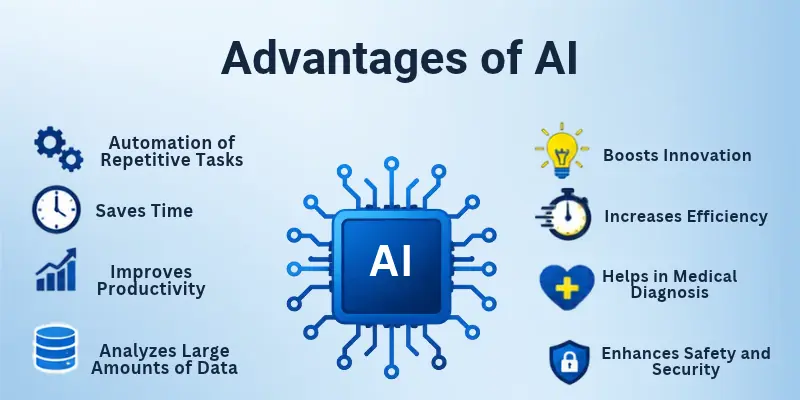
The following are 20 important advantages of AI.
- Automation of Repetitive Tasks
- Saves Time
- Improves Productivity
- Analyzes Large Amounts of Data
- Reduces Human Errors
- Provides 24/7 Availability
- Supports Better Decision-Making
- Improves Customer Support
- Personalizes User Experiences
- Helps in Healthcare
- Supports Education and Learning
- Improves Workplace Safety
- Assists in Problem-Solving
- Speeds Up Research
- Improves Accessibility
- Helps with Content Creation
- Supports Business Growth
- Improves Fraud Detection
- Optimizes Transportation
- Encourages Innovation
Now, let’s discuss the advantages of AI in detail.
1. Automation of Repetitive Tasks
One of the main advantages of AI is its ability to automate repetitive tasks. Many jobs involve similar activities that must be completed again and again. AI-powered systems can handle some of these activities with less manual effort.
For example, AI can sort emails, organize data, process simple requests, and help businesses manage routine operations. This allows employees to spend more time on tasks that require human judgment and creativity.
AI automation can help with:
- Sorting emails and messages
- Organizing digital files
- Processing routine requests
- Updating records
- Performing repeated calculations
Use It Wisely: Automate suitable routine tasks, but review important results to make sure they are correct.
2. Saves Time
AI can help people complete certain tasks in less time. It can summarize long documents, generate initial drafts, search through information, and organize data much faster than many manual methods.
Students, writers, employees, and business owners can use AI to speed up everyday work. However, the time saved depends on the task and the quality of the AI tool being used.
AI can save time by:
- Summarizing lengthy information
- Creating first drafts
- Organizing research notes
- Finding patterns in data
- Answering common questions
Work Efficiently: Use AI to speed up routine work, then spend enough time checking the final result.
3. Improves Productivity
AI can help individuals and organizations complete more work with the resources they already have. It can assist with planning, writing, scheduling, data processing, and other everyday activities.
When people use AI correctly, they may complete tasks more efficiently and focus on higher-priority responsibilities. Still, productivity does not automatically improve if users spend too much time correcting inaccurate results.
AI can support productivity through:
- Task planning and organization
- Drafting reports and emails
- Preparing meeting summaries
- Managing routine workflows
- Supporting project research
Stay Productive: Choose AI tools that solve real problems instead of adding unnecessary steps to your work.
4. Analyzes Large Amounts of Data
AI can process large datasets and identify patterns that may be difficult for people to notice manually. Businesses and researchers can use these findings to understand trends, compare information, and investigate possible problems.
For example, an AI system may analyze customer feedback to identify common complaints. However, the results depend on the quality and relevance of the available data.
AI can help analyze:
- Customer feedback
- Sales records
- Website traffic
- Research findings
- Market trends
Check the Data: Use reliable information and verify important findings before making decisions based on AI analysis.
5. Reduces Human Errors
AI can reduce certain errors by following consistent instructions and checking information according to predefined rules. It can help identify missing fields, unusual transactions, spelling mistakes, and calculation problems.
However, AI is not completely error-free. It may misunderstand instructions, use incorrect information, or repeat mistakes found in its training data. Human review remains important, especially for high-risk tasks.
AI can help detect:
- Missing information
- Data entry mistakes
- Unusual transactions
- Spelling and grammar issues
- Inconsistent records
Review Important Results: Use AI as an additional checking method rather than assuming every result is accurate.
6. Provides 24/7 Availability
Many AI-powered services can operate around the clock without needing the same breaks as human workers. This is useful for online businesses, digital services, and customers who need assistance outside normal working hours.
For example, a chatbot can answer basic questions at night or on weekends. However, complicated problems may still require a human representative.
AI services can provide:
- Answers to common questions
- Basic website assistance
- Automated notifications
- Simple troubleshooting guidance
- Support outside office hours
Set Clear Limits: Make sure users can reach a human when an AI system cannot solve their problem.
7. Supports Better Decision-Making
AI can organize information, compare different options, and identify patterns that help people make informed decisions. Businesses may use it to understand customer behavior, estimate demand, or review performance.
AI recommendations should not replace human judgment. Decisions involving money, health, employment, or legal matters require careful evaluation and suitable expert advice.
AI can support decisions by:
- Comparing available options
- Identifying important trends
- Summarizing reports
- Estimating possible outcomes
- Highlighting unusual changes
Decide Responsibly: Consider AI recommendations alongside reliable evidence, experience, and human judgment.
8. Improves Customer Support
AI can help businesses respond to common customer questions more quickly. Chatbots and automated support systems can provide basic information about products, orders, services, and account procedures.
This can reduce waiting times for simple requests and help support teams manage larger numbers of customers. However, AI may struggle with unusual complaints or situations that require empathy.
AI customer support can help with:
- Answering frequently asked questions
- Sharing order information
- Explaining basic procedures
- Directing customers to relevant pages
- Collecting initial complaint details
Keep Support Helpful: Provide a clear option for customers to contact a real person when needed.
9. Personalizes User Experiences
AI can use available information about user preferences and behavior to suggest relevant content, products, or services. This is why many digital platforms provide personalized recommendations.
For example, a streaming service may suggest videos based on previous viewing activity. Personalization can make services more convenient, but it should respect user privacy and preferences.
AI personalization can include:
- Product recommendations
- Suggested videos and music
- Personalized learning activities
- Relevant search results
- Customized content suggestions
Respect Privacy: Personalization should be transparent and based on appropriate use of personal data.
10. Helps in Healthcare
AI can support healthcare professionals by helping them analyze medical images, organize patient information, and identify patterns in health data. Certain systems may assist with detecting signs of disease or prioritizing cases for further review.
AI does not replace qualified healthcare professionals. Medical decisions require professional evaluation because incorrect results can have serious consequences.
AI can support healthcare through:
- Medical image analysis
- Patient data organization
- Research assistance
- Appointment scheduling
- Monitoring selected health patterns
Prioritize Medical Expertise: Treat AI as a supporting tool and rely on qualified professionals for diagnosis and treatment decisions.
11. Supports Education and Learning
AI tools can help students understand difficult topics, practice language skills, summarize lessons, and receive explanations at different levels. Teachers can also use AI to prepare learning materials and create practice questions.
However, students may learn less if they copy AI-generated answers without understanding them. AI-generated information can also contain mistakes.
AI can support education by:
- Explaining difficult concepts
- Creating practice questions
- Summarizing study notes
- Supporting language practice
- Helping teachers prepare materials
Learn Actively: Use AI to understand a topic and practice your skills instead of copying answers without learning.
12. Improves Workplace Safety
AI can help identify potential workplace risks by analyzing information from cameras, sensors, machines, or monitoring systems. In suitable environments, it can alert workers to unusual conditions before a problem becomes more serious.
These systems can be useful in factories, warehouses, and other workplaces where equipment or environmental conditions may create risks. Their effectiveness depends on proper installation and maintenance.
AI safety systems can help with:
- Detecting equipment abnormalities
- Monitoring selected safety conditions
- Identifying restricted-area access
- Warning about possible hazards
- Supporting maintenance planning
Maintain Human Oversight: Combine AI monitoring with safety procedures, inspections, and trained personnel.
13. Assists in Problem-Solving
AI can help people explore possible solutions by organizing information, comparing alternatives, and generating ideas. It can be useful when someone needs a starting point for a technical, educational, or business problem.
However, a solution that sounds reasonable may not work in a real situation. Users should test suggestions before applying them.
AI can assist with:
- Generating possible solutions
- Explaining technical concepts
- Comparing alternatives
- Identifying possible causes
- Organizing troubleshooting steps
Test Before Applying: Check whether an AI-generated solution is practical, safe, and suitable for your situation.
14. Speeds Up Research
Researchers and professionals can use AI to summarize documents, organize notes, identify possible research directions, and analyze datasets. These features can make some research tasks more manageable.
AI may also provide false references or inaccurate summaries. Important claims should therefore be checked against original studies, official documents, or other trustworthy sources.
AI can support research by:
- Summarizing long documents
- Organizing research notes
- Finding patterns in datasets
- Generating research questions
- Comparing information from sources
Verify Every Claim: Check original sources before using AI-generated facts, quotations, or references in your work.
15. Improves Accessibility
AI can make digital services easier to use for people with different needs. Speech recognition, text-to-speech, captions, and image descriptions can help users interact with information in different ways.
These tools can support communication and access to digital content, although their accuracy varies across languages, accents, and situations.
AI accessibility features can include:
- Automatic speech transcription
- Text-to-speech conversion
- Caption generation
- Image descriptions
- Voice-controlled interactions
Choose Suitable Tools: Test accessibility features to ensure they meet the user’s specific needs.
16. Helps with Content Creation
AI can assist with creating initial drafts, brainstorming ideas, improving grammar, and organizing written content. It can also support the preparation of images, presentations, and other digital materials.
However, AI-generated content may sound generic, include errors, or lack original insight. Human editing helps make content more accurate, useful, and relevant to its audience.
AI can assist with:
- Blog post outlines
- Social media captions
- Email drafts
- Presentation ideas
- Grammar and readability checks
Add Human Value: Edit AI-generated content carefully and include accurate information, original thinking, and a clear purpose.
17. Supports Business Growth
Businesses can use AI to analyze customer needs, automate selected tasks, improve marketing workflows, and organize sales information. These uses may help businesses work more efficiently and identify opportunities.
However, adopting AI can require money, training, and ongoing maintenance. Results are not guaranteed, particularly when a business chooses unsuitable tools.
AI can support business activities through:
- Customer trend analysis
- Marketing research
- Sales forecasting
- Workflow automation
- Business reporting
Start with a Clear Goal: Choose AI tools that address a specific business need and measure whether they provide real value.
18. Improves Fraud Detection
AI can analyze transaction patterns and flag activities that appear unusual. Banks, payment providers, and other organizations may use such systems as part of their fraud prevention processes.
An unusual transaction does not always mean fraud, so false alerts are possible. Organizations need appropriate checks to protect customers and avoid unfair decisions.
AI can help identify:
- Unusual payment patterns
- Suspicious account activity
- Repeated transaction attempts
- Unexpected changes in behavior
- Potential security threats
Investigate Alerts Carefully: Combine automated detection with suitable verification procedures before taking action.
19. Optimizes Transportation
AI can help transportation systems analyze traffic, plan routes, and estimate travel times. Logistics companies may also use it to coordinate deliveries and improve fleet planning.
Actual results depend on traffic conditions, available data, road infrastructure, and how the system is implemented. AI-based transportation systems still need suitable safety controls.
AI can support transportation through:
- Route planning
- Traffic pattern analysis
- Delivery scheduling
- Fleet monitoring
- Travel time estimates
Use Reliable Guidance: Follow road rules and remain alert to changing conditions even when using AI-powered navigation.
20. Encourages Innovation
AI gives developers, researchers, businesses, and students new ways to explore ideas and build digital solutions. It can support experimentation, prototyping, and the development of services that would otherwise require more time or resources.
Innovation still depends on human creativity, careful planning, testing, and responsible implementation. AI can help generate ideas, but people must decide which ideas are useful.
AI can encourage innovation through:
- Rapid idea generation
- Software development assistance
- Product design support
- Research experimentation
- New digital services
Build Responsibly: Test new AI-based ideas and consider their safety, reliability, and effects on people.
Disadvantages of AI
Although AI offers many benefits, it also creates challenges for individuals, businesses, and society. Its limitations may affect employment, privacy, security, fairness, and the quality of information people receive.
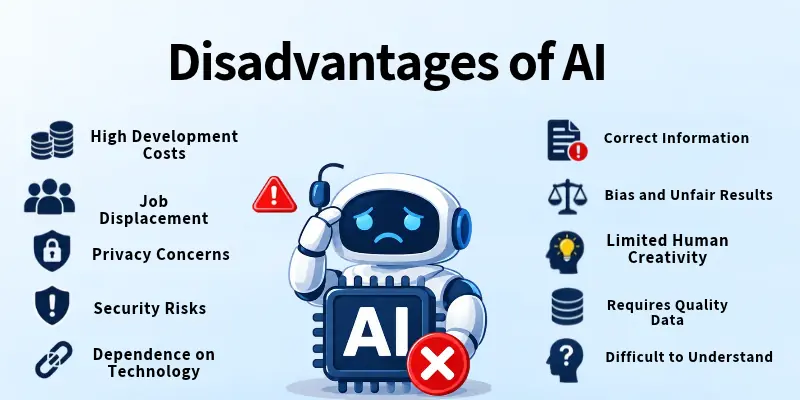
The following are 20 important disadvantages of AI.
- High Development Costs
- Job Displacement
- Lack of Human Emotions
- Privacy Concerns
- Dependence on Technology
- Incorrect Information
- Bias and Unfair Results
- Security Risks
- Limited Human Creativity
- Requires Quality Data
- Difficult to Understand
- Maintenance and Updates
- Reduced Human Interaction
- Ethical Concerns
- Environmental Impact
- Risk of Overdependence
- Limited Common Sense
- Legal and Accountability Issues
- Unequal Access to AI
- Potential Misuse
Now, let’s discuss the advantages of AI in detail.
1. High Development Costs
Developing and implementing advanced AI systems can require significant financial resources. Organizations may need specialized hardware, software, skilled professionals, testing, and ongoing technical support.
These costs can make advanced AI difficult to adopt for small businesses and individuals. Even when a tool is initially affordable, additional expenses may arise as usage increases.
AI costs may include:
- Software subscriptions
- Computing infrastructure
- Employee training
- System integration
- Ongoing technical support
Plan Your Budget: Compare the full cost of an AI solution with its expected benefits before investing in it.
2. Job Displacement
AI can automate certain tasks that people currently perform at work. As organizations adopt automation, some roles may shrink or change, particularly when jobs involve predictable and repetitive activities.
The effects vary by industry and occupation. AI can also create new roles, but workers may need additional training to move into changing job markets.
Employment challenges may include:
- Automation of routine tasks
- Changes in job responsibilities
- Reduced demand for some roles
- Need for new technical skills
- Pressure to adapt to new systems
Keep Learning: Develop adaptable skills, including communication, critical thinking, digital literacy, and problem-solving.
3. Lack of Human Emotions
AI can recognize certain emotional patterns in text, speech, or images, but it does not experience human emotions in the same way people do. It may produce supportive language without truly feeling empathy.
This limitation matters in situations that require compassion, trust, and an understanding of personal circumstances. AI responses may feel inappropriate when a person needs genuine human support.
AI may struggle with:
- Understanding complex feelings
- Responding to personal grief
- Building genuine emotional connections
- Interpreting subtle social cues
- Handling sensitive conversations appropriately
Keep People Involved: Use AI for suitable support tasks, but rely on human care when empathy and personal understanding are important.
4. Privacy Concerns
Some AI tools process user information to provide their services. If sensitive data is shared carelessly or handled improperly, it may create privacy risks.
The level of risk depends on the tool, its settings, the data it collects, and its privacy practices. Users should understand how their information may be stored or processed.
Privacy risks can involve:
- Sharing confidential documents
- Uploading personal information
- Collecting unnecessary user data
- Unauthorized data access
- Unclear data retention practices
Protect Personal Data: Avoid entering passwords, private records, or confidential business information into tools unless their security and data policies are suitable.
5. Dependence on Technology
Relying too heavily on AI can reduce opportunities to practice independent thinking and problem-solving. People may begin accepting automated suggestions without checking whether they make sense.
If an AI service becomes unavailable, users who depend on it for every task may struggle to continue their work. Maintaining basic skills helps reduce this risk.
Overdependence may lead to:
- Less independent problem-solving
- Reduced practice of important skills
- Difficulty working without digital tools
- Unquestioned acceptance of suggestions
- Problems during service interruptions
Maintain Your Skills: Try solving problems independently before using AI to review or improve your work.
6. Incorrect Information
AI systems can generate answers that sound confident but contain incorrect or misleading information. They may misunderstand a question, overlook important context, or present unsupported claims.
This can be particularly harmful when users rely on AI for medical, financial, legal, or academic decisions. Verification is essential before acting on important information.
Incorrect results may include:
- Inaccurate facts
- Misleading summaries
- Incorrect calculations
- Fake references
- Outdated information
Verify Important Answers: Check claims against reliable sources, especially when accuracy has serious consequences.
7. Bias and Unfair Results
AI systems can produce biased outcomes when their training data, design, or evaluation methods contain unfair patterns. This may affect decisions in areas such as recruitment, lending, education, and access to services.
Even when a system appears neutral, its results may disadvantage certain groups. Regular testing and human review can help identify and reduce these problems.
Bias can appear in:
- Recruitment recommendations
- Automated assessments
- Facial recognition systems
- Credit-related decisions
- Personalized recommendations
Check for Fairness: Test AI systems with appropriate data and review their results for unfair patterns before relying on them.
8. Security Risks
AI tools can introduce security risks if they are poorly designed, incorrectly configured, or used by attackers. Some systems may also process sensitive information that needs strong protection.
Organizations must consider security throughout the system’s development and use. AI alone cannot guarantee that a network, account, or digital service is safe.
Security concerns may include:
- Exposure of sensitive information
- AI-assisted phishing attempts
- Malicious use of generated content
- Vulnerabilities in connected systems
- Unauthorized access to accounts
Strengthen Security: Use strong access controls, keep software updated, and follow established cybersecurity practices.
9. Limited Human Creativity
AI can generate ideas, text, images, and designs by learning patterns from existing information. However, its output may lack the personal meaning, lived experience, or original perspective that people bring to creative work.
AI-generated material can also feel repetitive or similar to existing content. Human creators remain important for developing distinctive ideas and making thoughtful artistic choices.
Creative limitations may include:
- Repetitive writing styles
- Generic design suggestions
- Limited personal expression
- Weak understanding of cultural context
- Difficulty creating meaningful new perspectives
Add Your Own Ideas: Use AI as a starting point and improve the result with original thinking, personal judgment, and careful editing.
10. Requires Quality Data
AI systems often depend on data to learn patterns and produce useful results. If the available information is incomplete, outdated, inaccurate, or poorly organized, the system may perform badly.
Collecting suitable data can also be difficult when information is scattered across different sources or protected by privacy requirements.
Data-related problems can include:
- Missing information
- Outdated records
- Inaccurate entries
- Unbalanced datasets
- Difficulty collecting suitable data
Improve Data Quality: Review, clean, and update data before using it to train or evaluate an AI system.
11. Difficult to Understand
Some advanced AI systems are difficult to explain because their outputs result from complex interactions among many learned patterns. Users may receive a recommendation without understanding why the system produced it.
This can make it harder to investigate errors, challenge unfair outcomes, or decide whether a recommendation is reliable. The difficulty varies depending on the type of AI system.
Understanding challenges may involve:
- Unclear decision processes
- Limited explanations for results
- Difficulty investigating errors
- Problems auditing complex systems
- Reduced trust in automated decisions
Ask for Evidence: Prefer systems that provide useful explanations and supporting information when decisions need to be reviewed.
12. Maintenance and Updates
AI systems require ongoing monitoring, testing, and maintenance. Changes in data, software, user needs, or real-world conditions can reduce the quality of their results over time.
Organizations may need technical staff to fix problems, improve performance, update integrations, and monitor security. These responsibilities can increase the long-term cost of using AI.
Maintenance tasks may include:
- Software updates
- Performance monitoring
- Data quality checks
- Security testing
- Fixing system errors
Plan for Maintenance: Consider ongoing support and updates before adopting an AI solution.
13. Reduced Human Interaction
Using AI for communication and customer service can reduce direct contact between people. Although automated responses may be convenient, they can feel impersonal when someone needs detailed help or understanding.
This can create frustration if users cannot explain their situations to a real person. Businesses and institutions should balance automation with meaningful human support.
Reduced interaction may result in:
- Less direct communication
- Frustrating automated responses
- Difficulty explaining unusual problems
- Fewer personal connections
- Limited emotional understanding
Keep Human Support Available: Make it easy for people to speak with a qualified person when automated assistance is not enough.
14. Ethical Concerns
AI raises ethical questions about fairness, consent, privacy, transparency, and the responsible use of generated content. A system may be technically effective but still cause harm if its effects on people are ignored.
For example, organizations may need to consider whether users know they are interacting with AI and whether automated decisions can be challenged.
Ethical concerns can include:
- Unclear use of personal data
- Unfair automated decisions
- Misleading generated content
- Lack of transparency
- Unclear responsibility for harm
Use AI Responsibly: Establish clear rules, explain important uses of AI, and review its effects on people.
15. Environmental Impact
Training and operating some AI systems requires computing resources and electricity. Large-scale systems may also need cooling, hardware, and data-center infrastructure.
The environmental impact varies depending on the model, workload, energy source, and efficiency of the infrastructure. Not every AI task has the same environmental cost.
Environmental concerns may involve:
- Electricity consumption
- Data-center cooling
- Hardware production
- Electronic waste
- Demand for computing resources
Use Resources Efficiently: Choose suitable tools and avoid unnecessary AI processing when a simpler method can complete the task.
16. Risk of Overdependence
Overdependence occurs when people trust AI suggestions without checking them or using their own judgment. This is different from ordinary technology use because users may gradually stop evaluating information independently.
For example, a writer who accepts every generated paragraph without checking facts may publish incorrect information. A student who copies every answer may miss important learning opportunities.
Overdependence can lead to:
- Less critical thinking
- Poor verification habits
- Reduced confidence in personal skills
- Acceptance of unsuitable suggestions
- Difficulty identifying mistakes
Stay in Control: Treat AI output as a suggestion that requires your own evaluation.
17. Limited Common Sense
AI can recognize patterns and respond to many questions, but it may fail to understand everyday situations the way a person does. It can miss implied meanings, practical limitations, or important details that were not clearly included in a prompt.
As a result, an answer may sound logical while being unsuitable for the actual situation.
AI may struggle with:
- Ambiguous instructions
- Unusual real-world situations
- Hidden assumptions
- Context-dependent decisions
- Practical consequences
Provide Clear Context: Explain the situation carefully and check whether the suggested answer makes sense in the real world.
18. Legal and Accountability Issues
The use of AI can raise legal questions about data protection, copyright, discrimination, and responsibility for harmful outcomes. Rules also vary by country and by the type of application involved.
When an AI system makes a mistake, it may be difficult to determine who is responsible if several people or organizations contributed to its design and use.
Legal challenges may involve:
- Handling personal information
- Ownership of generated content
- Discriminatory outcomes
- Responsibility for harmful decisions
- Compliance with applicable laws
Check Legal Requirements: Review relevant laws and seek qualified legal advice for high-risk uses of AI.
19. Unequal Access to AI
Not everyone has equal access to reliable internet, modern devices, paid AI tools, or the training needed to use them effectively. This can create differences in the benefits people receive from AI technology.
Students, small businesses, and communities with limited digital resources may face additional barriers. Providing affordable access and digital education can help reduce these gaps.
Access challenges may include:
- Limited internet connectivity
- Expensive subscriptions
- Older devices
- Lack of digital skills
- Fewer training opportunities
Consider Accessibility: Choose affordable tools where possible and provide suitable training for people who need it.
20. Potential Misuse
AI can be misused to create deceptive messages, impersonate people, produce misleading images, automate scams, or spread false information. These activities can harm individuals, businesses, and communities.
The risk depends on the technology, how easily it can be accessed, and the safeguards around its use. Responsible development and public awareness are important for reducing misuse.
Potential misuse includes:
- Creating deceptive messages
- Generating misleading images
- Impersonating real people
- Supporting online scams
- Spreading false information
Use AI Ethically: Do not use AI to deceive, impersonate, exploit, or harm other people.
Common Uses of Artificial Intelligence
AI is used in many industries and everyday activities. Its role depends on the purpose of the application and the information it can access.
| Industry or Area | Common AI Uses |
| Education | Learning support, summaries, practice questions |
| Healthcare | Medical image analysis, research assistance |
| Business | Data analysis, workflow automation |
| Customer Service | Chatbots, common-question responses |
| Finance | Fraud detection, transaction monitoring |
| Transportation | Route planning, traffic analysis |
| E-commerce | Product recommendations, demand forecasting |
| Content Creation | Drafting, editing, idea generation |
| Cybersecurity | Threat detection, unusual activity alerts |
| Manufacturing | Equipment monitoring, quality inspection |
Factors to Consider Before Using AI
Choosing an AI tool requires more than looking at its features. You should consider whether it is suitable for your task, whether its results are reliable, and whether it protects your information.
1. Purpose: Decide what you want AI to help you accomplish. A tool designed for writing may not be suitable for analyzing complex datasets or handling confidential information.
2. Accuracy: Check how reliably the tool performs your task. Test its results and verify important claims before using them.
3. Cost: Consider subscription fees, usage limits, training, and other possible expenses. Choose a tool that fits your budget and provides useful value.
4. Privacy and Security: Review the tool’s data policies and security options. Avoid sharing sensitive information unless the service is appropriate for handling it.
5. Ease of Use: Choose a tool that you can use comfortably. Clear instructions and a simple interface can make it easier to achieve useful results.
6. Human Oversight: Determine which tasks require a person to check the output. Important decisions should not rely entirely on an automated recommendation.
Common Mistakes to Avoid When Using AI
AI can be helpful, but careless use may reduce the quality of your work or create unnecessary risks. Avoid these common mistakes.
- Trusting every answer: AI can produce inaccurate information, so verify important facts.
- Sharing sensitive data: Protect passwords, private records, and confidential documents.
- Copying content without editing: Review AI-generated material for accuracy, originality, and relevance.
- Using unclear prompts: Give enough context to help the tool understand your task.
- Ignoring bias: Consider whether the results may be unfair or incomplete.
- Depending on AI for every task: Continue developing your own knowledge and skills.
- Skipping human review: Check outputs before using them in important situations.
- Ignoring costs: Review subscription fees and other expenses before adopting a tool.
How to Use AI Effectively
You can get more useful results from AI by using it with a clear purpose and reviewing its output carefully.
- Define your task: Decide exactly what you want AI to help you do.
- Choose a suitable tool: Select a tool designed for that type of work.
- Write clear instructions: Include relevant context, requirements, and the format you need.
- Review the response: Look for missing details, mistakes, and unsupported claims.
- Verify important facts: Use reliable sources to confirm information.
- Edit the final result: Add your own judgment, knowledge, and ideas.
- Protect your information: Avoid sharing sensitive data unnecessarily.
- Evaluate the outcome: Check whether AI actually improved your work.
Quick Comparison: Advantages vs. Disadvantages of AI
| Advantages of AI | Disadvantages of AI |
| Automates repetitive tasks | Can replace some job tasks |
| Saves time | May produce incorrect information |
| Improves productivity | Can be expensive to implement |
| Analyzes large datasets | Depends on data quality |
| Helps detect certain errors | Can produce biased results |
| Provides round-the-clock service | Lacks genuine human emotions |
| Supports decision-making | May be difficult to explain |
| Personalizes user experiences | Creates privacy concerns |
| Assists healthcare and education | Requires human oversight |
| Supports business growth | Can be misused |
| Helps with research | Requires maintenance |
Final Thoughts
Artificial Intelligence offers many advantages, including automation, faster data analysis, improved productivity, and support for learning and research. It can help individuals and businesses complete certain tasks more efficiently when it is used appropriately.
However, AI also has important disadvantages. These include job displacement, privacy concerns, biased results, incorrect information, security risks, and the possibility of overdependence. Its benefits and limitations depend on the tool, the task, and the way people use it.
The best approach is to treat AI as a supporting technology rather than a replacement for human judgment. By checking its results, protecting personal information, and continuing to develop our own skills, we can benefit from AI while reducing its risks.
Frequently Asked Questions (FAQs)
Now, let’s explore some frequently asked questions.
1. What are the main advantages of AI?
The main advantages of AI include automating repetitive tasks, saving time, analyzing large amounts of data, supporting decision-making, and improving productivity.
2. What are the main disadvantages of AI?
The main disadvantages include potential job displacement, privacy concerns, incorrect information, biased results, high implementation costs, and security risks.
3. How is AI used in daily life?
AI is used in search engines, digital assistants, recommendation systems, navigation apps, spam filters, translation tools, and customer service chatbots.
4. Can AI replace human workers?
AI can automate certain tasks and may reduce demand for some roles. However, many jobs also require human judgment, communication, creativity, and responsibility. The effects depend on the occupation and how organizations adopt AI.
5. Is AI always accurate?
No. AI can misunderstand questions, generate incorrect information, or produce biased results. Important information should be verified using reliable sources.
6. How does AI affect students?
AI can help students understand difficult topics, organize notes, and practice skills. However, copying its answers without understanding them can reduce learning and may violate academic rules.
7. Is AI safe to use?
AI can be useful when used carefully, but its safety depends on the tool and the task. Users should protect private information, verify important results, and avoid relying on AI alone for high-risk decisions.
8. Can AI think like a human?
AI can perform tasks associated with human intelligence, such as recognizing patterns and generating language. However, this does not mean it has human experiences, emotions, or understanding.
9. Why is AI important?
AI is important because it can help people process information, automate tasks, support research, and develop new services. Its value depends on whether it solves a real problem responsibly.
10. How can we use AI responsibly?
We can use AI responsibly by checking its output, protecting personal data, considering fairness, following relevant rules, and keeping humans involved in important decisions.






- Be Respectful
- Stay Relevant
- Stay Positive
- True Feedback
- Encourage Discussion
- Avoid Spamming
- No Fake News
- Don't Copy-Paste
- No Personal Attacks
- Be Respectful
- Stay Relevant
- Stay Positive
- True Feedback
- Encourage Discussion
- Avoid Spamming
- No Fake News
- Don't Copy-Paste
- No Personal Attacks
